Tahoe Village HOA Snow Practices May Be Causing Damage to Homes
Key Facts
Snow has been mechanically pushed and stored against residential buildings for decades
Snow accumulation in this area has exceeded 12–17+ feet, far beyond natural conditions
The building at 331 Quaking Aspen is supported by a post-and-pier foundation, making it more sensitive to concentrated loading and erosion
Damage has been documented, including structural movement and repeated repairs
Initial repair estimate from TVHOA: ~$24,000 → later reduced to ~$6,000
No formal engineering report has been provided despite multiple evaluations
Owner Perspective
Ownership of multiple units within Tahoe Village over more than 25 years provides a long-term perspective on how snow management practices have evolved and their potential impact on structures.
Observations are not limited to a single property, but reflect conditions seen across multiple units within the community.
What's the Issue
Tahoe Village HOA collects snow from roadways and parking areas and repeatedly directs/piles it in concentrated areas against residential structures.
This creates conditions that differ significantly from natural snowfall, including increased loading, water concentration, and potential erosion near structural supports.
Multiple Buildings Affected with Documented Damage
Similar snow placement practices have been observed impacting more than one building within Tahoe Village, including both 331 Quaking Aspen and 339 Tramway.
Damage identified at 331 Quaking Aspen (larger scale)
Damage identified at 339 Tramway (smaller scale)
Both exposed to similar snow placement conditions
Observations at Nearby Structure
A nearby building, located approximately 15 feet away from the damage at 331 Quaking Aspen , has exhibited additional concerns, including foundation, siding and wall structural concerns
While the cause of these conditions remains under review, their proximity to documented snow placement raises questions regarding potential impacts of long-term snow accumulation practices.
Even where damage is smaller in scale, its presence in multiple locations under similar conditions raises questions about the broader impact of snow management practices.
HOA Position on Snow Placement
Concerns regarding snow placement near residential structures were formally raised with the Tahoe Village HOA Board.
In response, legal counsel for the HOA stated (click to see letters from attorney):
“There are no alternative locations to place snow, and the HOA will continue to place snow there as needed.”
The HOA further confirmed this is a long-standing practice:
“The Association and its contractors… have consistently done so over at least the last 30 years, probably longer.”
The request to stop placing snow in this area was formally declined.
See email response to attorney
Post-and-Beam Support/Foundation and Snow Storage Pile
-
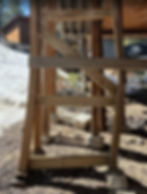
The building at 331 Quaking Aspen is constructed using a post-and-beam support system rather than a traditional continuous concrete foundation.
-
In this type of construction, vertical structural loads are transferred through individual posts rather than distributed across a continuous foundation wall.
-
Snow removal practices have historically resulted in large volumes of snow being placed directly against these structural posts.
-
This condition may expose critical load-bearing elements to prolonged snow loading, moisture, and freeze-thaw cycles.
-
Structures utilizing post-and-beam systems may be more sensitive to localized loading conditions compared to buildings with continuous concrete foundations.
-
The placement of snow directly against these structural elements raises questions about whether long-term loading and environmental exposure may contribute to observed damage.
Timeline
Concerns about snow storage issues raised approximately 3 years ago
Email notifying TVHOA about snow removal/ snow storage damage to 331 and 339 buildings submitted September 2024
The damage has been under Tahoe Village HOA review for over 18+ months.
Tahoe Village Board and Attorney state the snow has been placed in this area for 25+ years
Damage identified and documented
HOA responded through legal counsel
Insurance and consultant evaluations conducted
Repair scope has changed significantly
No formal engineering report has been provided
Snow storage practices changed recently
No defined timeline for resolution has been established
Lack of Formal Engineering Documentation
The HOA has stated that consulting engineers were involved in evaluating the property.
Initial repair estimate from TVHOA: ~$24,000 → later reduced to ~$6,000 with no engineering analysis supporting the revised scope
However, according to correspondence from the HOA’s attorney:
No formal engineering reports were prepared
No documented analysis
No signed findings
Conclusions were based on informal assessments
Conclusions were provided verbally to the attorney
No written reports will be provided
As a result, no formal documentation has been made available to support conclusions regarding the cause of structural issues.
Lack of Direct Engagement from Tahoe Village HOA Board
The initial request to stop piling snow against the 331 and 339 buildings was submitted to the Tahoe Village HOA Board. To date, there has been no direct communication from the Tahoe Village HOA Board regarding the conditions at 331 Quaking Aspen or 339 Tramway Drive.
No member of the Board has met me for an on-site meeting or walkthrough of either property.
Change in Snow Management Practices Winter 2026
👉 Snow was redirected to other areas
During the most recent winter season, snow stakes were installed to close snow removal equipment access to the area above the 331 Quaking Aspen building.
According to HOA correspondence, these were placed “in an effort to redirect snow storage to other areas"
This confirms that snow placement is operational and can be modified.
Following this change, observations during major storm events showed minimal natural snow accumulation near the 331 and 339 buildings.
It remains unclear under what conditions snow may again be placed in this area.
y Fact
Why This Matters to Owners
Snow management practices that concentrate large volumes of snow near structures may impact:
This is not just one building.
Structural integrity of buildings
Soil stability and erosion near foundations
Long-term maintenance costs
Property values and resale disclosures
Potential future HOA expenses or special assessments
For Current and Future Buyers
These conditions may be relevant to current homeowners and prospective buyers evaluating properties within Tahoe Village.
For more than 25+ years, snow from roads and parking areas has been pushed and piled down a hillside and against residential buildings in Tahoe Village.
Recent observations, documentation, and investigations suggest that this practice may contribute to structural damage, drainage concerns, and long-term property risk.
Share Your Experience
If you own property in Tahoe Village, your experience may help clarify whether this issue extends beyond a few buildings.
Unusual snow buildup near structures?
Structural movement or cracking?
Drainage or water concerns?
👉 Please share your experience or reach out.
Goal of This Site
This website exists to:
Share documented observations and findings
Encourage transparency and accountability
Connect homeowners who may be affected
Promote responsible snow management practices
Together, homeowners can ensure that property management decisions protect both structures and long-term property value.
This site is based on documented observations, correspondence, and materials provided through HOA and insurance process